Use and specifications
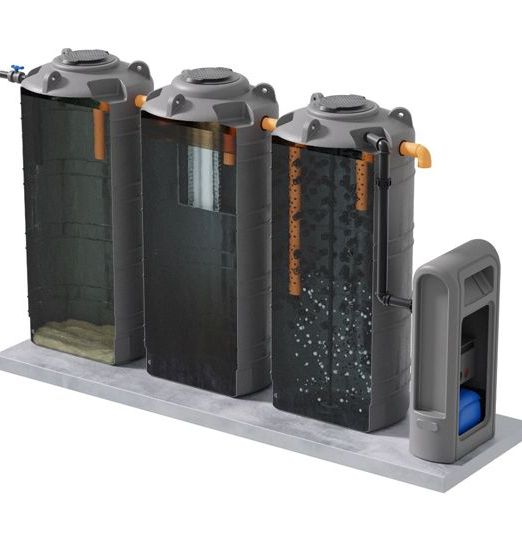
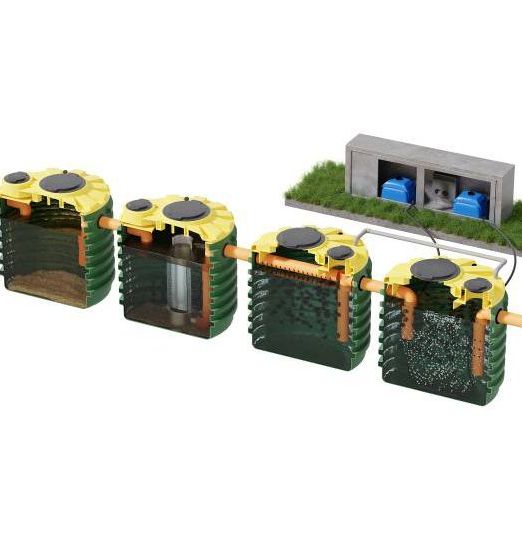
1. GRIT SEPARATOR: this is where all the compounds of specific weight different to that of water are separated by gravity: the heavier materials (sand, mud, gravel,…) settle to the bottom of the tank while the lighter materials (oil, grease, foam,…) accumulate at the surface. The outlet pipe draws from halfway down the tank to prevent the separated material from being drawn-off.
2. OIL SEPARATION TREATMENT: the residual oils and hydrocarbons are trapped by the coalescing filters, thus separating them from the effluent.
3. INTENSIVE BIOLOGICAL TREATMENT: in which particular strains of bacteria digest the dissolved organic substances (BOD5 and COD) and the detergents (Phosphorous). When discharging to a public sewer, the biological treatment consists of an aerated percolating filter.
TECHNICAL CHARACTERISTICS
The growing interest for environmental protection and safety is focussing more and more not only on treatment of domestic sewage or the like but also, particularly in recent years, on treatment systems for runoff from potentially polluted impermeable surfaces. This includes water from car washes, which is characterised by the presence of various types of pollutants such as: suspended solids (sand and mud, gravel, grit, plant residue,…), detergents, mineral oils and hydrocarbons. For this reason, the purification treatment of these effluents requires a series of phases that treat the pollutants in succession.
Choice of the different types of treatment varies according to the final discharge (to public sewer, to surface watercourse, to land or re-use).
The first phase consists of a grit separator in which all the compounds of specific weight different to that of water are separated by gravity: the heavier materials (sand, mud, gravel,…) settle to the bottom of the tank while the lighter materials (oil, grease, foam,…) accumulate at the surface.
The outlet pipe draws from halfway down the tank to prevent the separated material from being drawn-off. The second phase is the oil separation. The residual oils and hydrocarbons are trapped by the coalescing filters, thus separating them from the effluent.
In the third phase, the effluent is subjected to intensive biological treatment, in which the particular strains of bacteria digest the dissolved organic substances (BOD5 and COD) and the detergents (Phosphorous).
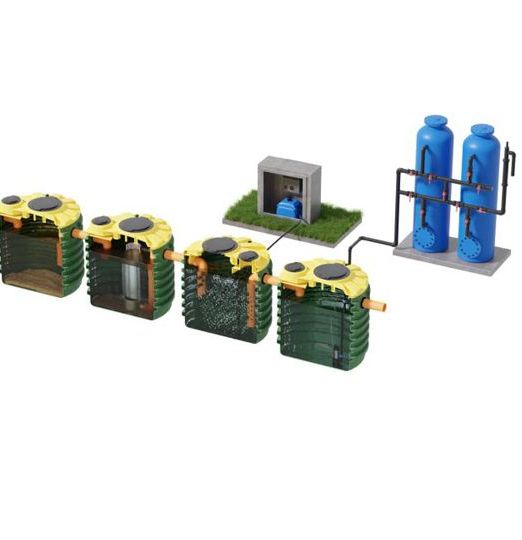
When discharging to a public sewer, the biological treatment consists of an aerated trickle filter. When discharging to a surface watercourse, another anaerobic trickle filter is added upstream. The blowers of the aerated trickle filters must remain in operation 24 hours a day.
Finally, to improve the quality of the treated water to discharge it into the open air/to the land or to re-use it in the initial phases of the washing cycle (pre-wash,…), the treatment plant is combined with a tertiary treatment consisting of a quartzite and activated charcoal filter system.
USE: treatment of water from manual and automatic car wash areas
REFERENCE REGULATIONS: Law Decree 152/2006, standard UNI EN 858-1 (oil separator), regional standards for treatment of rainwater and runoff.
INSTALLATION DIAGRAM

Please contact us to request an estimate or any other information on the product!